

Batchelor Institute logo
Acknowledgement of country

Batchelor Institute would like to acknowledge and pay respect to the Aboriginal and Torres Strait Islander sovereign people of the lands on which our campuses are located. As we share our knowledge, teaching and learning and engage in research practices within this Institution and/or conduct business with a variety of external agencies and organisations, we must always pay respect to the sovereign status of our hosts. May their Ancestors always be remembered and honoured, their Elders listened to and respected, all members treated with dignity and fairness — in the present and well into the future.

We also acknowledge and pay respect to the knowledge embedded forever with our hosts, custodianship of country and the binding relationship they have with the land. Batchelor Institute extends this acknowledgment and expression of respect to all sovereign custodians — past, present and emerging. By expressing Acknowledgement of Country we encourage all to extend and practice respect to all First Nations people wherever their lands are located.

Please read this important information
It is a condition of use of the Batchelor Institute of Indigenous Tertiary Education website that users ensure that any disclosure of the information contained in the website is consistent with the views and sensitivities of the Aboriginal and Torres Strait Islander peoples.
This includes:
Language
Users are warned that there may be words and descriptions which may be culturally sensitive and which might not normally be used in certain public or community contexts. Terms and annotations, which reflect the author’s attitude or that of the period in which the item was written, may be considered inappropriate today in some circumstances.
Deceased persons
Users of the website should be aware that, in some Aboriginal and Torres Strait Islander Communities, seeing images of deceased persons in photographs, film and books or hearing them in recordings may cause sadness or distress and in some cases, offend against strongly held cultural prohibitions.
Access conditions
Materials included in this website may be subject to access conditions imposed by Indigenous communities and/or depositors. Users are advised that access to some materials may be subject to these terms and conditions which the Institute is required to maintain
Application details
Position No.

.pdf, .doc, .docx maxiumum file size 8mb

Thank you for your application

Our Batchelor Institute team will get back to you shortly.

Inter-Library loan form
4 characters left

Item

Single article/chapter

Declaration

  • • I hereby request you to make and supply me with a copy of the article or extract listed on this application, which I require for the purpose of research or study.
  • • I have not previously been supplied with a copy of the said article or extract by a librarian.
  • • I have undertaken that if a copy is supplied to me, I will not use it except for the purposes of research or study.
  • • I have read and understood the above statement.
Thank you for your application

Our Batchelor Institute team will get back to you shortly.

Send your enquiry and a Batchelor team member will get back to you shortly
Thank you for contacting us

Our Batchelor Institute team will get back to you shortly.

Search
Batchelor staff contribute to major national review of First Nations student experiences
17 December 2025
7 minute read

National recognition

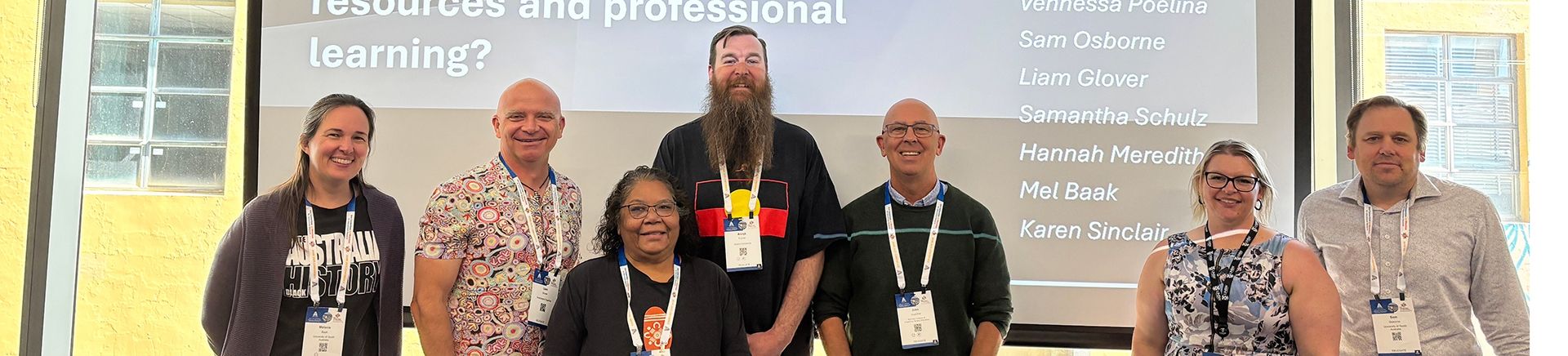
Batchelor Institute’s Dr John Guenther and Dr Robyn Ober have joined a diverse team of researchers from across Australia to co-author a significant new study on schooling in Australia.

The publication is a cross-institutional collaboration involving scholars from the University of South Australia, University of Notre Dame Australia, Deakin University, and the University of Adelaide.

Supported by funding from Australians Together, the article "First Nations students lived experiences of Australian schooling: A systematic literature review" was recently published in Issues in Educational Research.

This comprehensive review brings together 15 years of scholarship to amplify the voices of First Nations students. By contributing their expertise to this broader team, John and Robyn have helped highlight critical insights into how institutional structures impact students and the vital importance of connection to Country and community.

Abstract:

This systematic literature review explores how First Nations students have spoken about their lived experiences of middle to secondary schooling within Australia. Employing established and trustworthy systematic processes, the key findings across 57 publications for the past 15 years (early 2011 to late 2025) indicate that institutional factors, such as settler-colonial structures of power and control that enforce culturally-unsafe rules and restrictions have the biggest impact on First Nations students lived experiences.

However, when First Nations students’ identities are deeply connected with Country, community, and sovereignty and acknowledged via constructive and positive relationships, they are able to envision success as a First Nations person. The take-away provided by this systematic review is that several interwoven factors affect First Nations students’ lived experiences in Australian schooling and that it is no longer acceptable to ignore the overwhelming evidence of what changes are needed. The experiences shared by First Nations students affirm that it is time for educational decision-makers to listen, and for policies and processes of schooling to change to meet the needs and aspirations of First Nations students.

Read the full paper

We congratulate John, Robyn, and the entire authorship team on this collaborative achievement.

You can read the full article at the link below:

https://www.iier.org.au/iier35/weuffen-abs.html