
Batchelor Institute logo
Acknowledgement of country

Batchelor Institute would like to acknowledge and pay respect to the Aboriginal and Torres Strait Islander sovereign people of the lands on which our campuses are located. As we share our knowledge, teaching and learning and engage in research practices within this Institution and/or conduct business with a variety of external agencies and organisations, we must always pay respect to the sovereign status of our hosts. May their Ancestors always be remembered and honoured, their Elders listened to and respected, all members treated with dignity and fairness — in the present and well into the future.

We also acknowledge and pay respect to the knowledge embedded forever with our hosts, custodianship of country and the binding relationship they have with the land. Batchelor Institute extends this acknowledgment and expression of respect to all sovereign custodians — past, present and emerging. By expressing Acknowledgement of Country we encourage all to extend and practice respect to all First Nations people wherever their lands are located.

Please read this important information
It is a condition of use of the Batchelor Institute of Indigenous Tertiary Education website that users ensure that any disclosure of the information contained in the website is consistent with the views and sensitivities of the Aboriginal and Torres Strait Islander peoples.
This includes:
Language
Users are warned that there may be words and descriptions which may be culturally sensitive and which might not normally be used in certain public or community contexts. Terms and annotations, which reflect the author’s attitude or that of the period in which the item was written, may be considered inappropriate today in some circumstances.
Deceased persons
Users of the website should be aware that, in some Aboriginal and Torres Strait Islander Communities, seeing images of deceased persons in photographs, film and books or hearing them in recordings may cause sadness or distress and in some cases, offend against strongly held cultural prohibitions.
Access conditions
Materials included in this website may be subject to access conditions imposed by Indigenous communities and/or depositors. Users are advised that access to some materials may be subject to these terms and conditions which the Institute is required to maintain
Application details
Position No.

.pdf, .doc, .docx maxiumum file size 8mb

Thank you for your application

Our Batchelor Institute team will get back to you shortly.

Inter-Library loan form
4 characters left

Item

Single article/chapter

Declaration

  • • I hereby request you to make and supply me with a copy of the article or extract listed on this application, which I require for the purpose of research or study.
  • • I have not previously been supplied with a copy of the said article or extract by a librarian.
  • • I have undertaken that if a copy is supplied to me, I will not use it except for the purposes of research or study.
  • • I have read and understood the above statement.
Thank you for your application

Our Batchelor Institute team will get back to you shortly.

Send your enquiry and a Batchelor team member will get back to you shortly
Thank you for contacting us

Our Batchelor Institute team will get back to you shortly.

Search
Ngoonjook 37
3 minute read

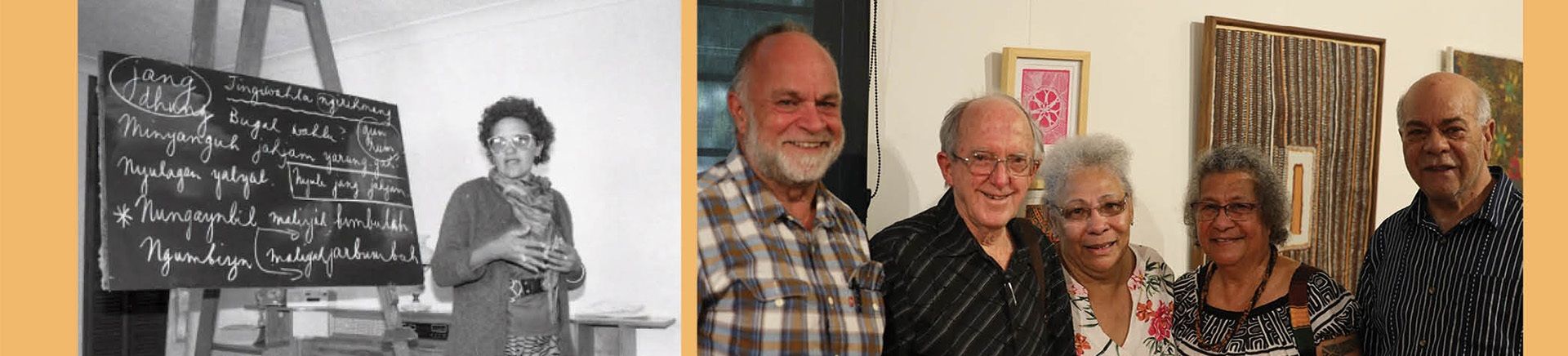
Ngoonjook means ‘news’ or ‘listen up’ in the language of the Kungarakan People. It is the name of the Institute’s journal, now known as Ngoonjook, Australian First Nations’ Journal, which has been in print for almost 40 years. Issue no. 37 went to press in March, and looks back to the Institute’s momentous 50th Anniversary Symposium, Learning journeys: Land and Language.

The Learning journeys: Land and Language theme is significant for the Institute because ‘Language’ has been an integral part of the Institute’s educational journey. This is reflected in particular VET and Higher Education courses over the years as well as through the establishment of the Institute’s Centre for Australian Languages and Linguistics and Batchelor Institute Press, both dedicated to developing resources for endangered language programs.

Ngoonjook 37 brings together 13 presentations from former and current Institute staff and students along with other institutional and independent representatives. The presentations complement and build on each other. The paper from Sashanna and Shania Armstrong on the Pertame Language Nest, for example, finds a theoretical voice in Haye van der Meer’s comparative study of First Nations and Finnish models of learning, and a global echo through The Lego Project as introduced by Kathryn Gilbey and Marie Ellis. Bilingual education is central to the paper by Yalmay Yunupingu, Leon White and Kathy McMahon, as both-ways learning is to Rob McCormack’s reflections as an Institute lecturer and how students reshaped his own learning journey.

While Ngoonjook 37 is dedicated to the 50th Anniversary Symposium and to Kathryn Gilbey whose decades-long work at the Institute recently came to an end, the symposium was dedicated to pioneering Aboriginal linguist Jeanie Bell (1994-2024). This issue includes a Foreword by Professor Curtis Roman, Dean of Higher Education and Research, Batchelor Institute, accompanied by other contributors including: Clair Andersen, Stephanie Barber, Helen Bishop, Joyce Bonner, N’arweet Carolyn Briggs, Robyn Heckenberg, Sadie Heckenberg, Michelle Hogue, Robyn Ober, Maurice O’Riordan and Patricia Mamanyjun Torres.
     
Details: 164 pages + softcover, 23 x 15cm, full-colour including 50th Anniversary-related photographs by Charlee-Anne Ah Chee, rrp: $25

Enquiries: batchelorpress@batchelor.edu.au