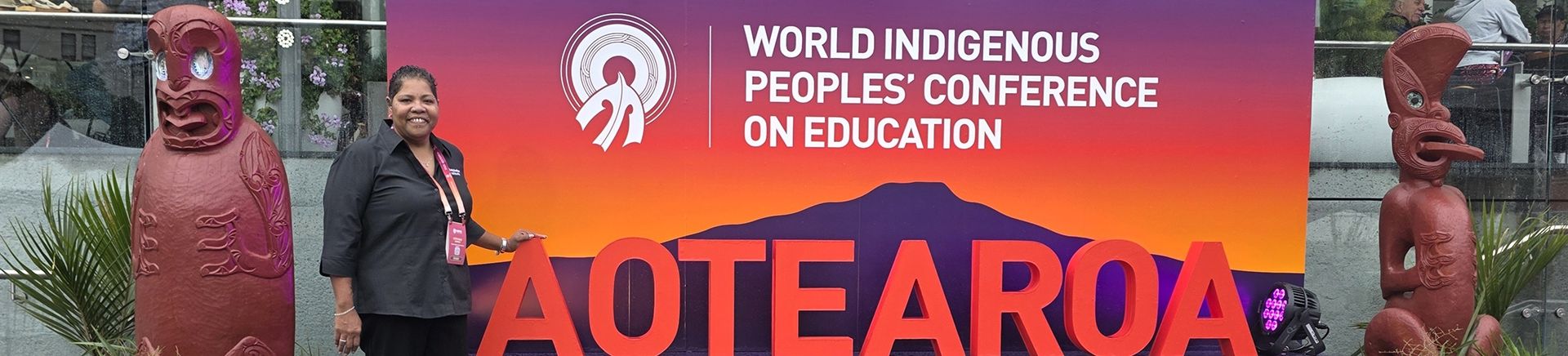

Indigenous-led approaches to education, health and wellbeing were shared on the global stage at the World Indigenous Peoples’ Conference on Education (WIPCE) in Aotearoa, New Zealand in November 2025.
Staff members from our Student and Residential Services team participated in WIPCE 2025 with a presentation showcasing the Student and Residential Services Suitcase Metaphor (S & R Suitcase Metaphor). The S & R Suitcase Metaphor is a holistic framework that supports Aboriginal and Torres Strait Islander students throughout their education journey, highlighting our Both Ways education approach.
Manager of Student and Residential Services, Stephanie Barber, who is Meriam Samsep and Dhoeybaw from the Torres Strait and Yandruwandah from Innaminka, South Australia, said the presentation emphasised the importance of viewing education through a cultural lens, recognising that meaningful outcomes are achieved when cultural perspectives guide how support is designed and delivered.
“Approach, impact, outcome, innovation and significance is achieved by looking through our cultural lens and adjusting our cultural shifts to support our people through their education journey.”
The S & R Suitcase Metaphor also challenges simplified understandings of Indigenous knowledge systems, highlighting the diversity of cultures, perspectives and ways of knowing carried by students into education.
As Australia’s only Indigenous-led dual-sector tertiary provider, Batchelor Institute positions Aboriginal and Torres Strait Islander peoples as knowledge holders in all educational interactions. Our Both Ways approach honours and elevates First Nations knowledge systems, ensuring they stand equal to Western education in every learning and research experience. This culturally grounded education strengthens our students’ identities, builds capability and empowers students for success.
WIPCE 2025 provided a valuable international platform to share this work and contribute to global conversations on Indigenous-led education, health and wellbeing. The conference reinforced the importance of culturally grounded, holistic approaches that empower and support First Nations students and communities through education.