
Teaching Arrernte our way: Sisters graduate as First Nations language teachers
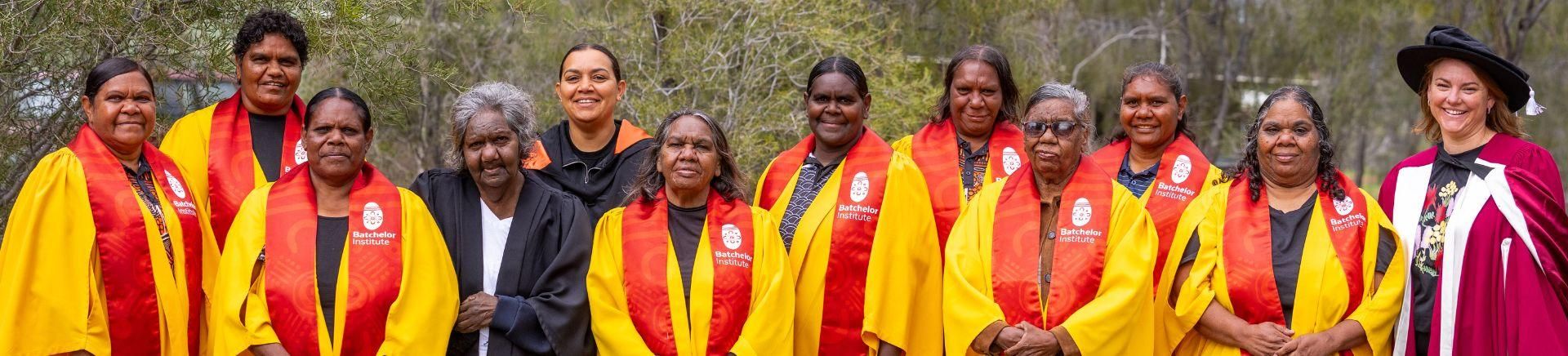
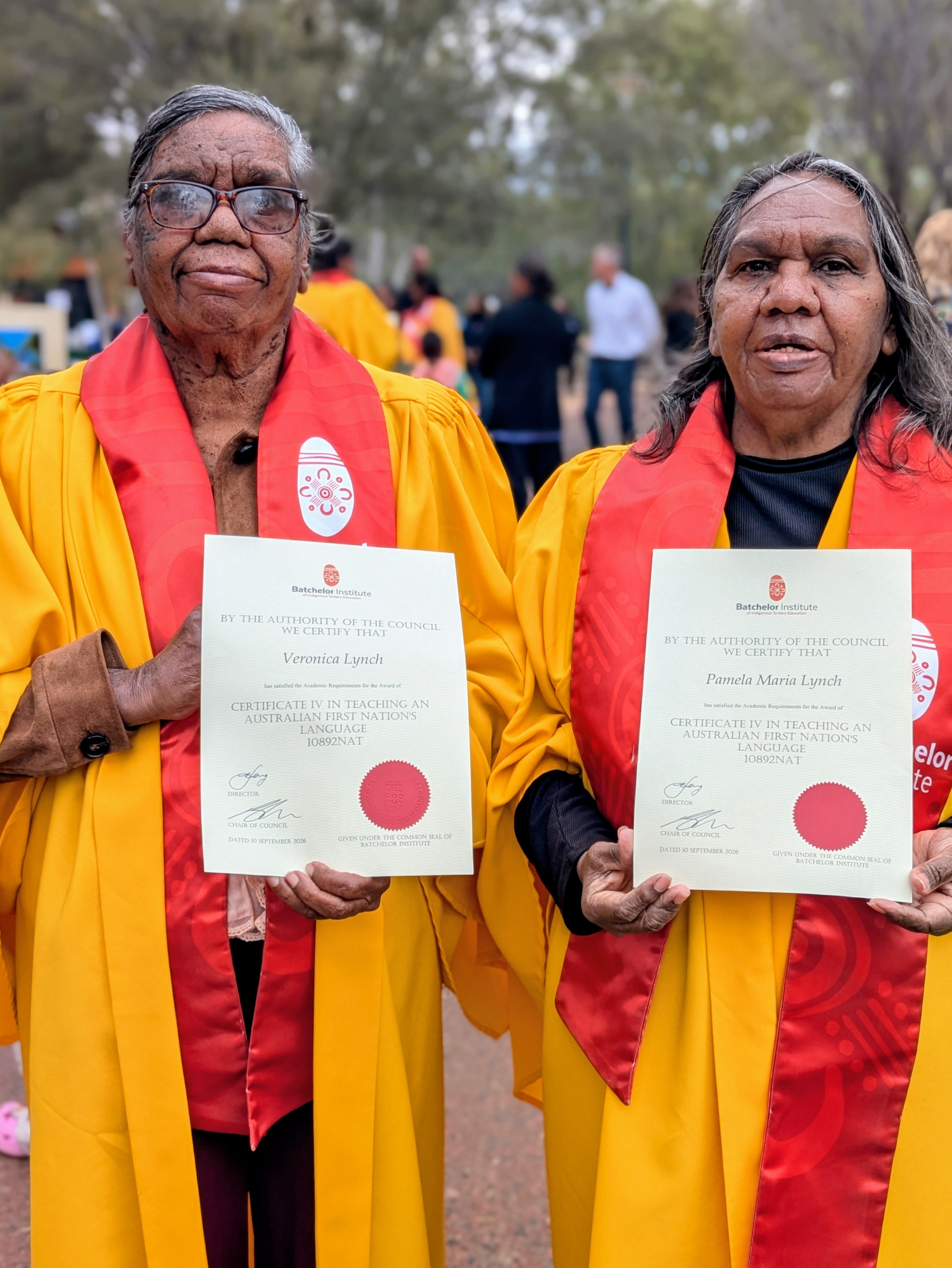
On 10 September 2026, at the Desert Peoples Centre Graduation Ceremony on Arrernte Country in Mparntwe (Alice Springs), sisters Pamela Maria Lynch and Veronica Lynch took the stage with their fellow graduates. What they carried away that day was not just a certificate, it was a promise to Country, to family and to the next generation of Arrernte speakers.
Together they delivered the student response. Their message was simple and clear - Arrernte is taught on homelands, with Elders’ knowledge leading and with young people coming through.
Each received the 10892NAT Certificate IV in Teaching an Australian First Nation’s Language.*
Language holders, teachers in the making
Pamela Kngwarraye Lynch was born in Apmere Mparntwe on 30 August 1959. She is Arrernte and Anmatyerre. In her address she named her parents, Don Peltherre Lynch from Mpweringe Anarpipe and Nancy Pengarte Lynch of Ilewerre and Ulpmerre-arenye, and the values they taught on Country, honesty, patience, curiosity and cultural responsibility across generations past, present and emerging.
Those values sit behind the work she already does. Pamela facilitates on Country learning with schools and immersion groups, locally and nationally. Having already completed a Certificate IV in Training and Assessment and a Certificate IV in Business Governance, the language teaching qualification, she told the ceremony, is the next step in a longer journey, teaching Arrernte stories on Country at Apmere Apmwerre.
“A yearning and passion for learning and teaching Arrernte stories on country, Apmere Apmwerre, Blacktank Homeland grew in me,” Pamela said.
“I thank you from the bottom of my heart for this opportunity to further my journey to create an Indigenous learning environment for my people.”
Veronica Lynch Kngwarraye spoke as Apmere-ketweye (Traditional Owner) of Apmwerre Blacktank Homeland and named Ngkwarle Untyeye Arltyerre, Corkwood Nectar Dreaming. The homeland sits about 85 kilometres north-east of Alice Springs, along the Arltunga Tourist Drive. It was established in 1984.
For Veronica, the Certificate IV is a tool for leadership that was already being practised, teaching on Country, looking after Country the way Elders taught it, and passing cultural knowledge to young people and community members.
“With this achievement of receiving a Cert IV, I will be able to teach on Country Learning to our young people and other members of the community,” Veronica said.
“I will be able to continue to provide leadership within our young people and other community members to understand, learn and gain more skills for looking after our country our way, what was taught to me by my elders.”
A dream already on the record
This graduation does not arrive out of nowhere. In March and April 2026 the sisters were among students of 10892NAT Certificate IV in Teaching an Australian First Nation’s Language who spent a week at the Desert Peoples Centre working on metalanguage, the language used to describe how a language works, so they can teach Arrernte with both cultural authority and classroom confidence. That workshop, guided by Arrernte Elder and linguist Veronica Dobson AM and trainer Dr Emma Browne, is told in full in Exploring the Language About Language: Strengthening Arrernte Through Both-Ways Learning.
In that story Pamela named the community ambition that still sits at the centre of this work, an on-Country learning centre for Arrernte families at Apmere Apmwerre (Black Tank). At graduation she returned to the same hope, an Arrernte language working group, learning and teaching on Country, with a cup of strong white tea in hand.
The sisters have also spoken publicly as language champions through Batchelor Institute’s Centre for Australian Languages and Linguistics (CALL) podcast Let’s Talk Language. In that episode they describe how policy and station-work changes in their childhood interrupted the natural passing of Arrernte from adults to children in town, and why, as older adults, they are working to strengthen the language for the generations coming behind them.
Both Ways, on Arrernte Country
Batchelor Institute is Australia’s only Indigenous dual-sector tertiary education provider. Through Both Ways learning, Aboriginal and Torres Strait Islander knowledges stand equal with Western education. The Certificate IV in Teaching an Australian First Nation’s Language is built for that purpose. It prepares Aboriginal and Torres Strait Islander language holders to teach their language in schools, early childhood settings, community programs and on Country, using curriculum tools without handing authority for the language to someone else.
That is the point of this graduation. Pamela and Veronica are not collecting a credential for its own sake. They are adding formal teaching skills to knowledge that already lives in family, Dreaming and homeland. The Institute’s role is to walk with that work, not to replace it.
“This is our dream,” Veronica told the room, “and I want to say congratulations to all the students here who have worked hard to make their own dreams come true.”
Pamela closed in language: Kele mwerre.
Congratulations Veronica and Pamela on your graduation, and on the words you offered from the stage. By speaking so clearly about teaching Arrernte on Country, you have given others a picture of what is possible when the work is done with love, skilland purpose.
Learn and teach language with Batchelor Institute
If you are an Aboriginal or Torres Strait Islander person ready to strengthen and teach your language, Batchelor Institute offers accredited pathways in learning and teaching an Australian First Nation’s language, delivered through VET in collaboration with CALL. New enrolments in the teaching qualification are under 11391NAT Certificate IV in Teaching an Australian First Nation’s Language. Workshops run at Batchelor Campus, the Desert Peoples Centre in Mparntwe and in regional centres.
Enquire about First Nations language courses or contact VET and the Higher Education and Research Division to find out when the next Desert Peoples Centre workshops are running.
Batchelor Institute of Indigenous Tertiary Education: RTO 0383 · TEQSA PRV12068
The Institute acknowledges the Arrernte people as the Traditional Custodians of Mparntwe, where the Desert Peoples Centre stands, and all Custodians of the Countries on which we live, learn and work.
*The qualification has now changed to 11391NAT Certificate IV in Teaching an Australian First Nation’s Language for current and future enrolments.